You just got back from Bali. Five days, four friends, zero arguments — until someone has to send that message.
You know the one.
"Heyy guys! Great trip!! Here's what everyone owes me haha"
The "haha" at the end is doing a lot of heavy lifting.
Someone reacts with a 👍. Another says "sending now!" and doesn't. Two leave it on read. And you — who booked the Airbnb, paid for the Grab rides, and covered dinner on night three — are left refreshing your banking app, wondering why it feels so hard to ask to be paid back.
The real problem isn't the money. It's the maths nobody wants to do.
When five people split expenses across a trip, someone owes someone something. Without a system, settling it fairly can require up to 8 separate transactions between five people. Nobody does that. Instead, debts get rounded down, quietly forgotten, and the friendship absorbs the cost.
This is exactly what debt simplification solves.
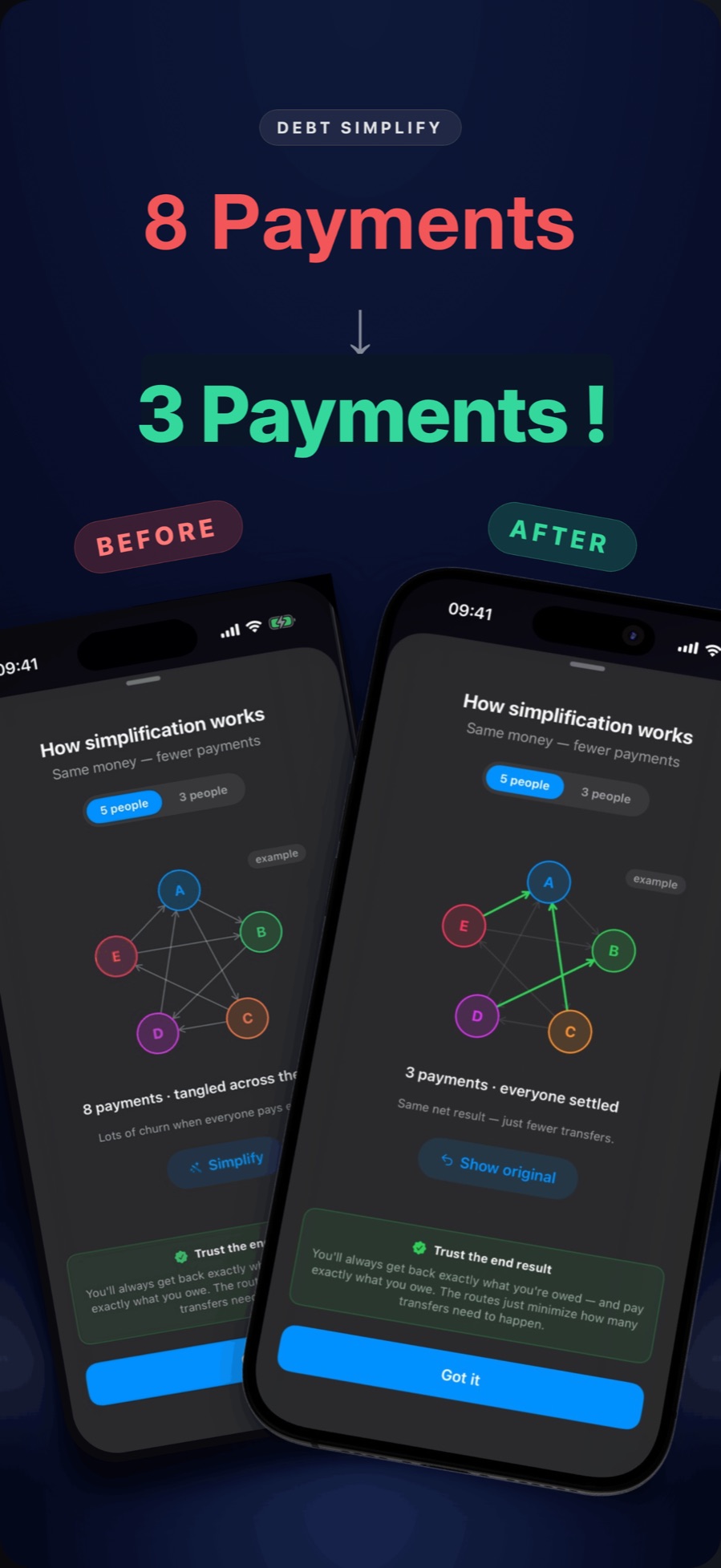
Debt simplification is a mathematical algorithm — definitely not AI (which hallucinates) — that looks at the full picture of who paid what across the entire trip and calculates the minimum number of payments needed to settle everyone fairly. Eight transactions become three. Everyone's balanced. Nobody overpays.
So why don't people trust it?
Almost every major bill-splitting app — Splitwise, Tricount, and others — uses some version of debt simplification. But they all do the same frustrating thing: they show you the result, not the process.
Normally:
You key in your expenses → the app spits out a number → you're expected to trust it and transfer.
That's fine, until someone like Tiong says, "Eh, that doesn't look right." Nobody can remember if the cash taxi fare was included. Or until one person in the group feels short-changed — and there's no way to check.
When money is involved between friends, "trust me bro" is not a system.
Here's where a bill-splitting app's transparency is paramount.
Why PaySoon is built differently
PaySoon was built on one principle: everyone should be able to see exactly how every number was reached.
When PaySoon simplifies your group's debts, it doesn't just hand you a final figure. It shows you the full breakdown — which expenses were included, how each person's balance was calculated, and how the simplified payments were arrived at.
Every step is visible. Nothing is hidden.
This matters because debt simplification only works if everyone trusts the result. And trust requires more than a number on a screen. It requires being able to see not just what you owe, but exactly why.
That's what every other bill-splitting app is missing. That's what PaySoon is built around.
The bottom line
Debt simplification is the right solution. But it only works when everyone in the group can see the work — not just the answer.
That's what every other app is missing. That's what PaySoon is built around.